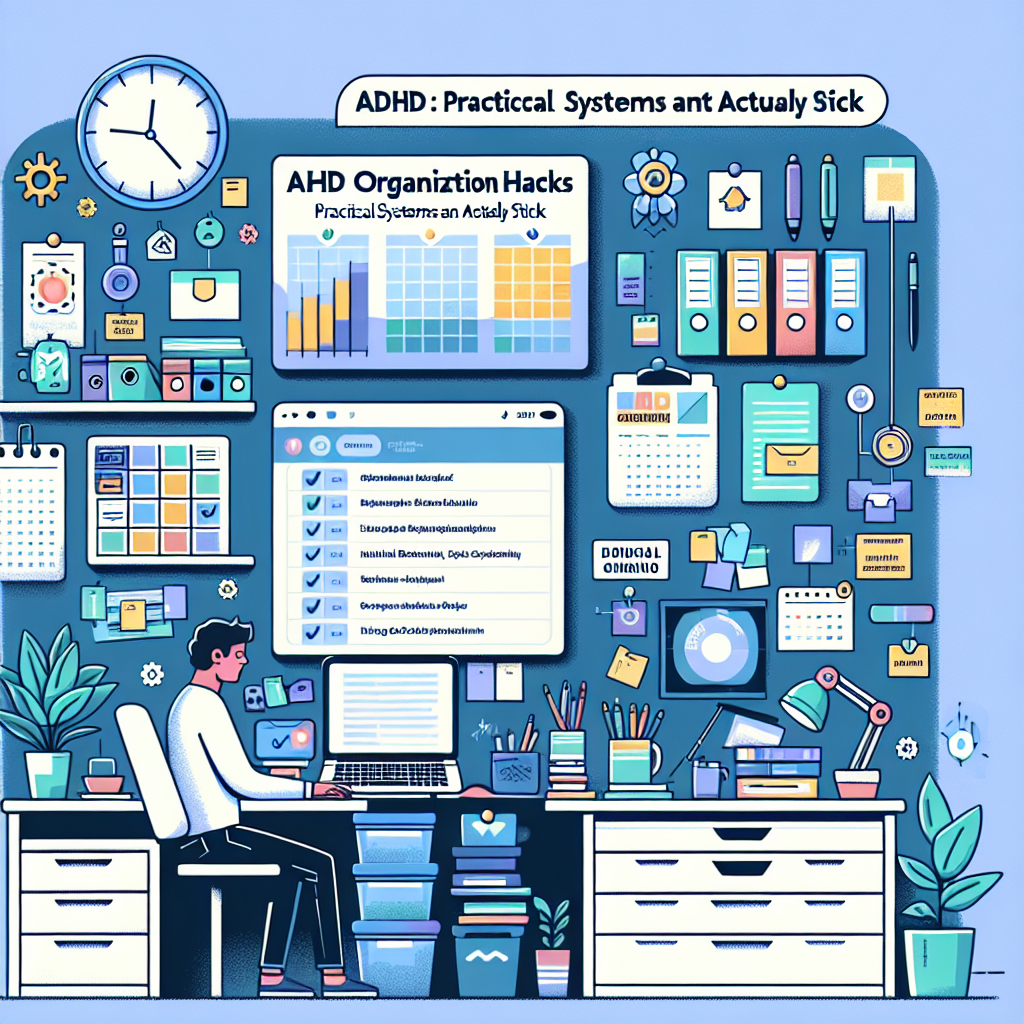
ADHD Organization Hacks: Practical Systems That Actually Stick
Understanding Executive Functioning Challenges in ADHD
Imagine trying to juggle flaming torches while riding a unicycle on a tightrope — that’s what managing everyday tasks can feel like for adults with ADHD. With executive functioning challenges, the brain's ability to plan, prioritize, and execute tasks can feel like an uphill battle.
Research shows that nearly 50% of adults with ADHD struggle significantly with executive functioning. This isn’t just about being disorganized; it’s like having a GPS that keeps recalculating your route every five minutes. You know where you want to go, but the directions keep changing.
The Components of Executive Functioning
Executive functioning encompasses several key components: working memory, cognitive flexibility, and inhibitory control. Think of these as the three musketeers of productivity. Without them working in harmony, tasks can easily fall through the cracks.
- Working Memory: Keeping track of information while using it.
- Cognitive Flexibility: Adapting to new situations or changes.
- Inhibitory Control: Resisting impulses and distractions.
So what does this mean for someone wondering how to stay organized with ADHD? Well, when these components are out of sync, simple tasks like sorting mail or planning a grocery list can become monumental challenges.
Real-World Implications
I’ll just remember to pick up milk on my way home, is often an optimistic thought that quickly dissolves into regret once you pass the grocery store. Adults with ADHD may forget essential items or appointments not because they don’t care but because their brains are wired differently.
Forgetfulness isn’t laziness; it’s a symptom of how executive functioning works (or doesn’t) in ADHD.
But there’s hope! Implementing practical systems tailored to these unique challenges can make all the difference. For instance, using visual reminders or technology can help bridge those gaps in memory and organization.
So what should you do next? Start by identifying which aspects of executive functioning are most challenging for you. Is it remembering appointments? Or perhaps switching between tasks? Once you pinpoint your pain points, you can tailor strategies that address those specific areas.
Imagine trying to juggle flaming torches while riding a unicycle on a tightrope — that’s what managing everyday tasks can feel like for adults with ADHD. With executive functioning challenges, the brain's ability to plan, prioritize, and execute tasks can feel like an uphill battle.
Research shows that nearly 50% of adults with ADHD struggle significantly with executive functioning. This isn’t just about being disorganized; it’s like having a GPS that keeps recalculating your route every five minutes. You know where you want to go, but the directions keep changing.
The Components of Executive Functioning
Executive functioning encompasses several key components: working memory, cognitive flexibility, and inhibitory control. Think of these as the three musketeers of productivity. Without them working in harmony, tasks can easily fall through the cracks.
- Working Memory: Keeping track of information while using it.
- Cognitive Flexibility: Adapting to new situations or changes.
- Inhibitory Control: Resisting impulses and distractions.
So what does this mean for someone wondering how to stay organized with ADHD? Well, when these components are out of sync, simple tasks like sorting mail or planning a grocery list can become monumental challenges.
Real-World Implications
I’ll just remember to pick up milk on my way home, is often an optimistic thought that quickly dissolves into regret once you pass the grocery store. Adults with ADHD may forget essential items or appointments not because they don’t care but because their brains are wired differently.
Forgetfulness isn’t laziness; it’s a symptom of how executive functioning works (or doesn’t) in ADHD.
But there’s hope! Implementing practical systems tailored to these unique challenges can make all the difference. For instance, using visual reminders or technology can help bridge those gaps in memory and organization.
So what should you do next? Start by identifying which aspects of executive functioning are most challenging for you. Is it remembering appointments? Or perhaps switching between tasks? Once you pinpoint your pain points, you can tailor strategies that address those specific areas.
Tailoring Organizational Systems to Individual Needs
Ever tried using someone else's calendar system only to end up more confused than before? You’re not alone! Many adults with ADHD find that cookie-cutter organizational systems often miss the mark, leaving them feeling overwhelmed and frustrated. The secret sauce? Customization.
Take Sarah, for example. A freelance graphic designer with ADHD, she struggled to keep her projects organized using a standard planner. Deadlines slipped through the cracks like sand in an hourglass. After some trial and error, she ditched the traditional planner for a color-coded digital tool that allowed her to visualize her projects in a way that made sense to her brain. Suddenly, deadlines were no longer a mystery; they were clear and manageable.
Understanding Your Unique Needs
The first step in tailoring your organizational system is understanding your specific needs. What works for one person might feel like a burden to another. For instance, if you find that lists overwhelm you, consider using visual aids like flowcharts or mind maps instead. These can help you see connections without feeling bogged down by details.
- Identify your biggest organizational pain points.
- Experiment with different tools: apps, physical planners, sticky notes.
- Seek feedback from trusted friends or family who understand your challenges.
Customization is key — what works for someone else may not work for you!
Implementing Flexible Systems
Once you've identified your needs, it’s time to implement flexible systems that can adapt as your life changes. For instance, if you’re juggling multiple projects at once, consider using project management software like Trello or Asana that allows you to move tasks around easily as priorities shift. This flexibility can help reduce anxiety about keeping everything straight.
But wait, you might say, What if I forget to check my project management tool? Good question! Incorporate reminders into your routine — set up notifications on your phone or place sticky notes where you’ll see them regularly (like on your bathroom mirror).
Trial and Error is Your Best Friend
Remember: it’s all about finding what resonates with you. If something isn’t working after a couple of weeks, don’t hesitate to pivot! Flexibility is essential when figuring out how to stay organized with ADHD.
Ultimately, remember that there’s no one-size-fits-all solution when it comes to organization for adults with ADHD. By tailoring systems that fit your unique needs and preferences, you're setting yourself up for success rather than frustration.
Ever tried using someone else's calendar system only to end up more confused than before? You’re not alone! Many adults with ADHD find that cookie-cutter organizational systems often miss the mark, leaving them feeling overwhelmed and frustrated. The secret sauce? Customization.
Take Sarah, for example. A freelance graphic designer with ADHD, she struggled to keep her projects organized using a standard planner. Deadlines slipped through the cracks like sand in an hourglass. After some trial and error, she ditched the traditional planner for a color-coded digital tool that allowed her to visualize her projects in a way that made sense to her brain. Suddenly, deadlines were no longer a mystery; they were clear and manageable.
Understanding Your Unique Needs
The first step in tailoring your organizational system is understanding your specific needs. What works for one person might feel like a burden to another. For instance, if you find that lists overwhelm you, consider using visual aids like flowcharts or mind maps instead. These can help you see connections without feeling bogged down by details.
- Identify your biggest organizational pain points.
- Experiment with different tools: apps, physical planners, sticky notes.
- Seek feedback from trusted friends or family who understand your challenges.
Customization is key — what works for someone else may not work for you!
Implementing Flexible Systems
Once you've identified your needs, it’s time to implement flexible systems that can adapt as your life changes. For instance, if you’re juggling multiple projects at once, consider using project management software like Trello or Asana that allows you to move tasks around easily as priorities shift. This flexibility can help reduce anxiety about keeping everything straight.
But wait, you might say, What if I forget to check my project management tool? Good question! Incorporate reminders into your routine — set up notifications on your phone or place sticky notes where you’ll see them regularly (like on your bathroom mirror).
Trial and Error is Your Best Friend
Remember: it’s all about finding what resonates with you. If something isn’t working after a couple of weeks, don’t hesitate to pivot! Flexibility is essential when figuring out how to stay organized with ADHD.
Ultimately, remember that there’s no one-size-fits-all solution when it comes to organization for adults with ADHD. By tailoring systems that fit your unique needs and preferences, you're setting yourself up for success rather than frustration.
Utilizing Digital Tools for Enhanced Organization
Digital tools are like the Swiss Army knives of organization — versatile, handy, and often lifesavers for adults trying to navigate the chaos of ADHD. Think about it: a recent study found that people with ADHD can manage their tasks up to 40% more effectively when they use digital tools tailored to their needs. That’s a game-changer!
Imagine Jake, a marketing consultant with ADHD who used to rely on crumpled sticky notes and a calendar that looked like it survived a tornado. As deadlines loomed, he’d find himself scrambling, wondering where his last-minute reminders went. Enter digital organization tools — specifically, task management apps like Todoist and Notion.
Choosing the Right Tools
The first step is figuring out which tools suit your style. Are you more visual? Check out Trello, with its colorful boards and drag-and-drop functionality. Prefer lists? Todoist has your back with its simple interface and project categorization.
- Trello: Great for visual planners who need to see tasks in progress.
- Todoist: Perfect for list lovers who thrive on checkboxes.
- Notion: A flexible workspace that combines notes, tasks, and databases.
The best tool is the one you actually use!
Integrating Reminders and Notifications
Out of sight, out of mind is an all-too-familiar phrase for those managing ADHD. So how do you keep those digital tools from gathering virtual dust? Set up notifications! Most apps allow you to schedule reminders that ping your phone or email when deadlines approach or tasks are due.
But what if I ignore the notifications? Good question! Consider pairing reminders with something you can’t ignore — like your morning coffee routine or during your evening wind-down time. This way, checking your task list becomes part of your daily habits.
Gamify Your Tasks
Here’s where it gets fun: gamification! Using apps like Habitica can transform mundane tasks into an adventure game where completing chores earns you points and rewards. It’s like turning your life into a video game — who wouldn’t want that?
Jake switched to Notion after seeing how others used it creatively to manage everything from work projects to personal goals. He customized his workspace to include visual elements that appealed to him — colors, icons, even motivational quotes! The result? He felt more in control than ever before.
So what’s next? Take some time this week to explore different digital tools that resonate with you. Experimentation is key; don’t hesitate to try multiple options until you find the perfect fit for how to stay organized with ADHD!
Digital tools are like the Swiss Army knives of organization — versatile, handy, and often lifesavers for adults trying to navigate the chaos of ADHD. Think about it: a recent study found that people with ADHD can manage their tasks up to 40% more effectively when they use digital tools tailored to their needs. That’s a game-changer!
Imagine Jake, a marketing consultant with ADHD who used to rely on crumpled sticky notes and a calendar that looked like it survived a tornado. As deadlines loomed, he’d find himself scrambling, wondering where his last-minute reminders went. Enter digital organization tools — specifically, task management apps like Todoist and Notion.
Choosing the Right Tools
The first step is figuring out which tools suit your style. Are you more visual? Check out Trello, with its colorful boards and drag-and-drop functionality. Prefer lists? Todoist has your back with its simple interface and project categorization.
- Trello: Great for visual planners who need to see tasks in progress.
- Todoist: Perfect for list lovers who thrive on checkboxes.
- Notion: A flexible workspace that combines notes, tasks, and databases.
The best tool is the one you actually use!
Integrating Reminders and Notifications
Out of sight, out of mind is an all-too-familiar phrase for those managing ADHD. So how do you keep those digital tools from gathering virtual dust? Set up notifications! Most apps allow you to schedule reminders that ping your phone or email when deadlines approach or tasks are due.
But what if I ignore the notifications? Good question! Consider pairing reminders with something you can’t ignore — like your morning coffee routine or during your evening wind-down time. This way, checking your task list becomes part of your daily habits.
Gamify Your Tasks
Here’s where it gets fun: gamification! Using apps like Habitica can transform mundane tasks into an adventure game where completing chores earns you points and rewards. It’s like turning your life into a video game — who wouldn’t want that?
Jake switched to Notion after seeing how others used it creatively to manage everything from work projects to personal goals. He customized his workspace to include visual elements that appealed to him — colors, icons, even motivational quotes! The result? He felt more in control than ever before.
So what’s next? Take some time this week to explore different digital tools that resonate with you. Experimentation is key; don’t hesitate to try multiple options until you find the perfect fit for how to stay organized with ADHD!
Implementing Physical Organization Strategies at Home and Work
Ever walked into a room and felt like a tornado just blew through? That’s what it can feel like for many adults with ADHD when faced with clutter. It’s not just a mess; it’s a mental block that can derail focus and productivity faster than you can say where did I put my keys?
Studies show that a chaotic environment can hinder cognitive performance by up to 30%. For someone already navigating the challenges of ADHD, this statistic isn’t just alarming — it’s motivation to tackle physical organization head-on.
Decluttering: The First Step to Clarity
Imagine your workspace as a canvas. If it's cluttered with old papers, half-finished projects, and mystery items from last year’s office party, how can you expect to create anything beautiful? Start by decluttering your space. Set aside time each week to tackle one area at a time — whether it’s your desk, kitchen counter, or closet. You’ll be amazed at what you find (and what you no longer need).
- Choose one area to declutter.
- Sort items into three piles: keep, donate, and toss.
- Clean the surface before putting back only what you need.
Less is more applies here — the less clutter around you, the clearer your mind will be.
Creating Designated Spaces
A place for everything and everything in its place isn’t just a catchy phrase; it’s an organizational mantra! Designate specific spots for everything you use regularly. This could mean using labeled bins for supplies or even color-coding files in your office. When everything has its own home, you'll save time searching for items — which is crucial when you're trying to stay organized with ADHD.
- 'Use drawer organizers for pens and office supplies.
- 'Label boxes clearly for easy access.
- 'Create a command center at home with calendars, reminders, and essential documents.
The Power of Visual Reminders
Visual reminders are like friendly nudges from your environment. Sticky notes on your bathroom mirror or colorful charts on your wall can serve as powerful tools in reinforcing tasks and responsibilities. They’re especially beneficial if traditional reminders slip through the cracks of an ADHD brain.
Consider creating a vision board that outlines not only tasks but also goals and aspirations. This keeps motivation high while providing constant visual cues about what needs attention.
Visual reminders help reinforce memory retention — they’re like having an extra brain hanging around!
Routine: The Glue That Holds It Together
Finally, establish routines around organization. For instance, set aside ten minutes each evening to tidy up your workspace or home before winding down for the night. This small habit creates momentum that makes larger organizational efforts easier down the line.
- Schedule regular decluttering sessions (weekly or monthly).
- Incorporate organization into existing routines (like cleaning after dinner).
- Use timers to create short bursts of focused organizing.
Ever walked into a room and felt like a tornado just blew through? That’s what it can feel like for many adults with ADHD when faced with clutter. It’s not just a mess; it’s a mental block that can derail focus and productivity faster than you can say where did I put my keys?
Studies show that a chaotic environment can hinder cognitive performance by up to 30%. For someone already navigating the challenges of ADHD, this statistic isn’t just alarming — it’s motivation to tackle physical organization head-on.
Decluttering: The First Step to Clarity
Imagine your workspace as a canvas. If it's cluttered with old papers, half-finished projects, and mystery items from last year’s office party, how can you expect to create anything beautiful? Start by decluttering your space. Set aside time each week to tackle one area at a time — whether it’s your desk, kitchen counter, or closet. You’ll be amazed at what you find (and what you no longer need).
- Choose one area to declutter.
- Sort items into three piles: keep, donate, and toss.
- Clean the surface before putting back only what you need.
Less is more applies here — the less clutter around you, the clearer your mind will be.
Creating Designated Spaces
A place for everything and everything in its place isn’t just a catchy phrase; it’s an organizational mantra! Designate specific spots for everything you use regularly. This could mean using labeled bins for supplies or even color-coding files in your office. When everything has its own home, you'll save time searching for items — which is crucial when you're trying to stay organized with ADHD.
- 'Use drawer organizers for pens and office supplies.
- 'Label boxes clearly for easy access.
- 'Create a command center at home with calendars, reminders, and essential documents.
The Power of Visual Reminders
Visual reminders are like friendly nudges from your environment. Sticky notes on your bathroom mirror or colorful charts on your wall can serve as powerful tools in reinforcing tasks and responsibilities. They’re especially beneficial if traditional reminders slip through the cracks of an ADHD brain.
Consider creating a vision board that outlines not only tasks but also goals and aspirations. This keeps motivation high while providing constant visual cues about what needs attention.
Visual reminders help reinforce memory retention — they’re like having an extra brain hanging around!
Routine: The Glue That Holds It Together
Finally, establish routines around organization. For instance, set aside ten minutes each evening to tidy up your workspace or home before winding down for the night. This small habit creates momentum that makes larger organizational efforts easier down the line.
- Schedule regular decluttering sessions (weekly or monthly).
- Incorporate organization into existing routines (like cleaning after dinner).
- Use timers to create short bursts of focused organizing.
Developing Routines That Promote Consistency and Accountability
Imagine waking up every morning with a plan that actually sticks — no more frantic searches for your keys or last-minute scrambles to meet deadlines. For adults with ADHD, this isn’t just a dream; it’s entirely achievable with the right routines in place.
Research indicates that establishing consistent routines can significantly improve focus and productivity for individuals with ADHD. In fact, studies show that structured environments can boost task completion rates by up to 60%. So, why not harness this power?
Start Small: The Micro-Habit Approach
Big changes can feel overwhelming, so let’s break it down into bite-sized pieces. Start by implementing micro-habits — tiny actions that take less than two minutes to complete. For example, instead of tackling the entire kitchen at once, begin with just loading the dishwasher. This small win builds momentum and makes it easier to tackle larger tasks later.
- Identify one small task you can do daily.
- Set a specific time for this task (like after breakfast).
- Celebrate your completion to reinforce the habit.
Create Accountability Partners
Who’s keeping you honest? is a great question when it comes to maintaining routines. Find an accountability partner — someone who understands your challenges and can help keep you on track. This could be a friend, family member, or even a therapist who checks in on your progress regularly.
But what if I forget our check-ins? Good point! Set calendar reminders or use shared digital tools like Google Calendar where both of you can see your commitments. This not only keeps you accountable but also helps build a sense of community around your goals.
Accountability isn’t just about keeping promises; it’s about creating connections that motivate change.
Routine Review: Weekly Check-Ins
Routine review sounds fancy, but it’s simply setting aside time each week to evaluate what worked and what didn’t. Did you manage to stick to your micro-habits? Were there obstacles? Reflecting on these questions helps fine-tune your approach.
Imagine waking up every morning with a plan that actually sticks — no more frantic searches for your keys or last-minute scrambles to meet deadlines. For adults with ADHD, this isn’t just a dream; it’s entirely achievable with the right routines in place.
Research indicates that establishing consistent routines can significantly improve focus and productivity for individuals with ADHD. In fact, studies show that structured environments can boost task completion rates by up to 60%. So, why not harness this power?
Start Small: The Micro-Habit Approach
Big changes can feel overwhelming, so let’s break it down into bite-sized pieces. Start by implementing micro-habits — tiny actions that take less than two minutes to complete. For example, instead of tackling the entire kitchen at once, begin with just loading the dishwasher. This small win builds momentum and makes it easier to tackle larger tasks later.
- Identify one small task you can do daily.
- Set a specific time for this task (like after breakfast).
- Celebrate your completion to reinforce the habit.
Create Accountability Partners
Who’s keeping you honest? is a great question when it comes to maintaining routines. Find an accountability partner — someone who understands your challenges and can help keep you on track. This could be a friend, family member, or even a therapist who checks in on your progress regularly.
But what if I forget our check-ins? Good point! Set calendar reminders or use shared digital tools like Google Calendar where both of you can see your commitments. This not only keeps you accountable but also helps build a sense of community around your goals.
Accountability isn’t just about keeping promises; it’s about creating connections that motivate change.
Routine Review: Weekly Check-Ins
Routine review sounds fancy, but it’s simply setting aside time each week to evaluate what worked and what didn’t. Did you manage to stick to your micro-habits? Were there obstacles? Reflecting on these questions helps fine-tune your approach.
Leveraging Time Management Techniques Specific to ADHD
Did you know that adults with ADHD often underestimate how long tasks will take by up to 50%? This time distortion can turn a simple project into a marathon of frustration. It’s like thinking you can whip up dinner in 15 minutes only to find yourself knee-deep in a culinary disaster an hour later.
To tackle this challenge head-on, let’s explore specific time management techniques that resonate particularly well with ADHD minds. These aren’t your run-of-the-mill tips; we’re talking about strategies designed to fit the unique wiring of your brain.
1. The Pomodoro Technique: Short Bursts for Big Wins
The Pomodoro Technique is like setting a timer for a sprint rather than a marathon. You work for 25 minutes, then take a 5-minute break. This structure can help maintain focus without feeling overwhelmed — perfect for those moments when your attention starts to drift like a leaf on the wind.
- Choose a task you want to tackle.
- Set a timer for 25 minutes.
- Work on the task until the timer goes off.
- Take a 5-minute break — grab some water or stretch!
- Repeat this cycle four times, then take a longer break (15-30 minutes).
Pro Tip: Use an app like Forest or Focus Keeper that gamifies the process, making it more engaging!
2. Time Blocking: Visualize Your Day
Time blocking sounds fancy, but it’s really just scheduling chunks of your day for specific tasks. Picture this: instead of having an endless list of things to do, you create blocks in your calendar dedicated solely to certain activities. This method not only clarifies what you need to accomplish but also sets boundaries around your time.
Did you know that adults with ADHD often underestimate how long tasks will take by up to 50%? This time distortion can turn a simple project into a marathon of frustration. It’s like thinking you can whip up dinner in 15 minutes only to find yourself knee-deep in a culinary disaster an hour later.
To tackle this challenge head-on, let’s explore specific time management techniques that resonate particularly well with ADHD minds. These aren’t your run-of-the-mill tips; we’re talking about strategies designed to fit the unique wiring of your brain.
1. The Pomodoro Technique: Short Bursts for Big Wins
The Pomodoro Technique is like setting a timer for a sprint rather than a marathon. You work for 25 minutes, then take a 5-minute break. This structure can help maintain focus without feeling overwhelmed — perfect for those moments when your attention starts to drift like a leaf on the wind.
- Choose a task you want to tackle.
- Set a timer for 25 minutes.
- Work on the task until the timer goes off.
- Take a 5-minute break — grab some water or stretch!
- Repeat this cycle four times, then take a longer break (15-30 minutes).
Pro Tip: Use an app like Forest or Focus Keeper that gamifies the process, making it more engaging!
2. Time Blocking: Visualize Your Day
Time blocking sounds fancy, but it’s really just scheduling chunks of your day for specific tasks. Picture this: instead of having an endless list of things to do, you create blocks in your calendar dedicated solely to certain activities. This method not only clarifies what you need to accomplish but also sets boundaries around your time.
Building Support Networks for Sustained Organizational Success
Picture this: Jamie, an ambitious project manager with ADHD, finds herself overwhelmed as deadlines loom. Despite her best efforts to stay organized, she often misses important meetings and forgets crucial tasks. Frustrated and feeling isolated, she realizes that navigating the chaotic waters of work is a lot easier with a trusty crew by her side.
Support networks are not just for therapy sessions; they’re essential for sustained organizational success. In fact, studies show that individuals with ADHD who actively engage in support systems report a 40% increase in task completion rates. That’s not just a number — it’s a lifeline!
Why Support Networks Matter
When you’re trying to figure out how to stay organized with ADHD, having a group of understanding allies can make all the difference. Support networks provide accountability, encouragement, and fresh perspectives that can help you navigate the complexities of organization. They also remind you that you’re not alone in this journey.
- Accountability: Regular check-ins help keep you on track.
- Encouragement: Celebrate small wins together.
- Diverse Perspectives: Gain insights from others’ experiences.
Creating Your Network
So how do you build this magical support network? Start by identifying people who understand your challenges — friends, family members, or colleagues who get it. Consider forming small groups where everyone can share their struggles and successes around organization.
But what if I’m too embarrassed to ask for help? That’s completely normal! Remember, vulnerability fosters connection. You might be surprised at how many people are willing to join you on this journey once you open up about your needs.
A shared struggle is half the battle.
The Buddy System: A Practical Approach
The Buddy System isn’t just for elementary school field trips; it can be your secret weapon against disorganization! Pair up with someone who has similar goals or challenges. You can bounce ideas off each other and hold each other accountable for staying organized.
Picture this: Jamie, an ambitious project manager with ADHD, finds herself overwhelmed as deadlines loom. Despite her best efforts to stay organized, she often misses important meetings and forgets crucial tasks. Frustrated and feeling isolated, she realizes that navigating the chaotic waters of work is a lot easier with a trusty crew by her side.
Support networks are not just for therapy sessions; they’re essential for sustained organizational success. In fact, studies show that individuals with ADHD who actively engage in support systems report a 40% increase in task completion rates. That’s not just a number — it’s a lifeline!
Why Support Networks Matter
When you’re trying to figure out how to stay organized with ADHD, having a group of understanding allies can make all the difference. Support networks provide accountability, encouragement, and fresh perspectives that can help you navigate the complexities of organization. They also remind you that you’re not alone in this journey.
- Accountability: Regular check-ins help keep you on track.
- Encouragement: Celebrate small wins together.
- Diverse Perspectives: Gain insights from others’ experiences.
Creating Your Network
So how do you build this magical support network? Start by identifying people who understand your challenges — friends, family members, or colleagues who get it. Consider forming small groups where everyone can share their struggles and successes around organization.
But what if I’m too embarrassed to ask for help? That’s completely normal! Remember, vulnerability fosters connection. You might be surprised at how many people are willing to join you on this journey once you open up about your needs.
A shared struggle is half the battle.
The Buddy System: A Practical Approach
The Buddy System isn’t just for elementary school field trips; it can be your secret weapon against disorganization! Pair up with someone who has similar goals or challenges. You can bounce ideas off each other and hold each other accountable for staying organized.
Evaluating and Adjusting Organizational Systems Over Time
Ever set up a shiny new organizational system only to watch it gather dust like an old trophy? You’re not alone! Many adults with ADHD find that what works one day might flop the next. The truth is, evaluating and adjusting your organizational systems isn’t just a good idea — it’s essential for long-term success.
According to research from the Journal of Attention Disorders, about 70% of adults with ADHD struggle to maintain effective organizational strategies over time. That’s a staggering number! It highlights the reality that our brains are wired differently, making it crucial to regularly assess and tweak our systems.
Recognizing When It's Time for Change
How do you know when your current system isn’t cutting it? Here are some telltale signs: you’re constantly losing items, missing deadlines, or feeling overwhelmed by clutter. If your planner looks more like a cryptic puzzle than a helpful tool, it might be time to shake things up!
- You frequently forget important tasks or appointments.
- Your workspace feels chaotic despite your best efforts.
- You dread looking at your planner because it feels unmanageable.
Feeling overwhelmed is a signal that adjustments are needed.
Strategies for Evaluation
Time for some self-reflection! Set aside time each week (yes, schedule it!) to evaluate what’s working and what’s not. Ask yourself questions like: Are my reminders effective? Do I still find my current tools helpful? This weekly check-in can be as enlightening as finding an extra fry at the bottom of the bag.
- Track your successes and failures: Keep a simple log of what worked well and what didn’t.
- Solicit feedback from trusted friends or family members who can provide an outside perspective.
- Consider using apps that allow you to adjust tasks easily based on changing priorities.
Trial-and-Error Mindset
Trial-and-error isn’t just a buzzword; it’s your best friend in this journey! If something isn't working after a couple of weeks, don’t hesitate to pivot. Think of it like trying on clothes: if they don’t fit right, you wouldn’t wear them just because they looked good on the hanger!
Ever set up a shiny new organizational system only to watch it gather dust like an old trophy? You’re not alone! Many adults with ADHD find that what works one day might flop the next. The truth is, evaluating and adjusting your organizational systems isn’t just a good idea — it’s essential for long-term success.
According to research from the Journal of Attention Disorders, about 70% of adults with ADHD struggle to maintain effective organizational strategies over time. That’s a staggering number! It highlights the reality that our brains are wired differently, making it crucial to regularly assess and tweak our systems.
Recognizing When It's Time for Change
How do you know when your current system isn’t cutting it? Here are some telltale signs: you’re constantly losing items, missing deadlines, or feeling overwhelmed by clutter. If your planner looks more like a cryptic puzzle than a helpful tool, it might be time to shake things up!
- You frequently forget important tasks or appointments.
- Your workspace feels chaotic despite your best efforts.
- You dread looking at your planner because it feels unmanageable.
Feeling overwhelmed is a signal that adjustments are needed.
Strategies for Evaluation
Time for some self-reflection! Set aside time each week (yes, schedule it!) to evaluate what’s working and what’s not. Ask yourself questions like: Are my reminders effective? Do I still find my current tools helpful? This weekly check-in can be as enlightening as finding an extra fry at the bottom of the bag.
- Track your successes and failures: Keep a simple log of what worked well and what didn’t.
- Solicit feedback from trusted friends or family members who can provide an outside perspective.
- Consider using apps that allow you to adjust tasks easily based on changing priorities.
Trial-and-Error Mindset
Trial-and-error isn’t just a buzzword; it’s your best friend in this journey! If something isn't working after a couple of weeks, don’t hesitate to pivot. Think of it like trying on clothes: if they don’t fit right, you wouldn’t wear them just because they looked good on the hanger!