
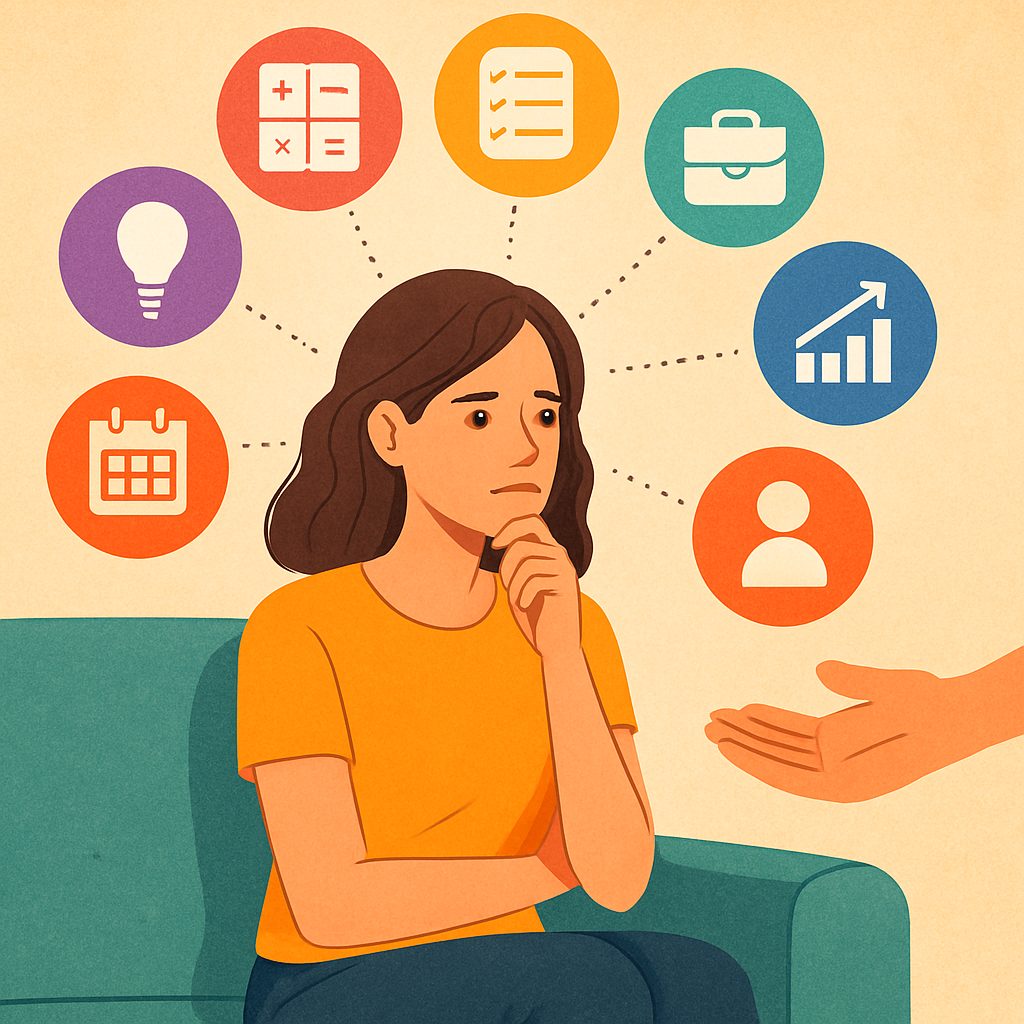
7 Core Adulting Skills Nobody Taught You — and How Therapy Helps You Build Them
Many young adults stumble through the transition to independence, especially when ADHD, anxiety, or busy schedules tug routines off course. This post outlines seven core adulting skills for young adults and pairs each with practical, therapy-informed strategies you can actually implement—no vague advice. Expect concrete steps, real-world tools, and anonymized examples that show how therapy can accelerate progress toward independence and stronger relationships.
1. Financial literacy and money management
Financial literacy isn't merely math; it's a prerequisite for independence. For young adults, it means mastering budgeting, avoiding debt traps, and building credit that doesn't trap you later. In ADHD contexts, impulse spending and messy bill tracking derail progress before the first paycheck lands.
Therapy-informed practice changes the game: CBT helps you reframe money behaviors as skills you can rehearse; external accountability—weekly check-ins with a therapist or coach—keeps you honest; contingency planning prepares you for slip-ups.
- Step 1: Set up a simple framework and automation: choose a budgeting approach such as 50/30/20 and enable autopay on recurring bills; in practice, set aside a fixed amount for savings as soon as income hits (pay yourself first). See your financial freedom blueprint.
- Step 2: Pick a budgeting tool and connect accounts: use YNAB YNAB or Mint Mint to categorize income and expenses and reduce manual entry; review weekly.
- Step 3: Create a 15-minute weekly money ritual: reconcile spending, adjust goals, and plan for upcoming bills; treat this as an appointment.
- Step 4: Build credit responsibly: consider a secured card or credit-builder product and set a plan to pay on time while keeping balances manageable.
Real-world anonymized example: Maya uses YNAB with weekly therapist-guided check-ins. Over a few months, she reduces late fees and keeps her balance in check while paying herself first.
Automation is powerful, but it's not a substitute for awareness. Autopay reduces late fees, yet without regular review you can overspend when income shifts or emergency bills appear. The practical limit is to couple automation with a standing weekly review so you catch anomalies before they cascade.
Takeaway: implement one automated flow today and schedule a weekly money review to maintain visibility.
2. Time management and planning
Time management isn't magic; it's a system you build around how ADHD shows up in your day. Time perception is uneven, and what feels like a minute can stretch into an hour when you’re juggling multiple tasks. The goal is external structure that captures time and reduces guesswork, not heroic self-control.
Actionable steps to build a durable time-management system
- Step 1 — Time-block the day: Schedule your top 3 priorities in fixed blocks, typically 60–90 minutes each, with 15–20 minute buffers to absorb overruns and transitions. Put these blocks on a calendar (prefer a digital tool like Google Calendar) and keep the same times each day to create cognitive anchors.
- Step 2 — Batch similar tasks: Group work into dedicated windows (emails, calls, errands) to minimize context switching. Do a 5-minute pre-planning sprint, then execute the batch, and reallocate any spillover to the next available block.
- Step 3 — Establish external accountability: Pair calendar commitments with weekly check-ins with a therapist, coach, or accountability partner. Use a simple template to report what you completed, what slid, and what you’ll try differently next week.
- Step 4 — Track lightweight metrics: Log daily focus time, on-time starts, and completed tasks. Use a tool like Todoist or a simple notebook, then review trends with your clinician or coach to adjust the system.
Real-world example: Aaron, a recent graduate, blocks 90-minute chunks for focused work and uses a therapist-guided weekly goal review. He starts each day by syncing the calendar with a 10-minute planning ritual and keeps a visible, color-coded plan on his desk.
Therapy supports skill-building here through several modalities. CBT helps reframe avoidance and builds concrete routines; DBT offers distress tolerance when plans slip and you feel overwhelmed; ACT nudges action aligned with your values, so time-misery doesn’t derail what matters.
To start in therapy, bring a snapshot of your current schedule: typical wake time, a sample day, and your top three priorities. A therapist will help you map those into a simple time-blocking framework, set weekly check-ins, and agree on milestones (e.g., two weeks of consistent blocks). Measure progress by whether you maintain the anchor blocks and reduce missed starts over time.
Takeaway: start with a single anchor time-block each day and build outward, adding buffers and accountability as you go.
3. Communication and boundary setting
Effective communication and boundary setting anchor work, friendships, and dating. For adults with ADHD, interruptions, misreading social cues, and boundary leakage make it easy to overstep and end up resentful.
Trade-offs matter here: setting boundaries costs emotional energy and may invite friction, but the payoff is clearer expectations, less overwhelm, and more reliable collaboration.
Framework in practice
A practical framework blends Nonviolent Communication for expressing needs, CBT-informed social skills practice to curb reflexive responses, and assertiveness training to own requests. You’re not aiming for perfection; you’re building muscle through structured, repeatable steps that work with ADHD tendencies rather than against them.
- Step 1: Prepare a boundary script that follows observation, impact, need, and a concrete request.
- Step 2: Role-play with a trusted friend or therapist to rehearse in low-stakes scenarios.
- Step 3: Schedule a 15-minute boundary check-in with key relationships on a weekly basis.
- Step 4: Use external cues like calendar reminders and a short breath pause before replying.
- Step 5: Debrief after conversations to refine the script and reduce boundary leakage.
Real-world example: Sophia uses a simple NVC-informed script with coworkers and partners. When a meeting runs long, she says that she observes the agenda not being followed, explains how the length affects her focus, states her need for a clear end time, and requests a hard stop at 45 minutes. The result is smoother meetings and fewer resentful afterlives of the day.
Therapy-informed approaches here commonly combine CBT for social skills, Nonviolent Communication techniques, and assertiveness training. DBT's interpersonal effectiveness skills can help you navigate pushback without melting into conflict, while practical coaching reinforces repeatable patterns that stick.
Practical tools that reinforce the framework include the Gottman Card Deck app for quick boundary prompts and structured scripts, plus a simple boundary-tracking sheet to monitor what works and what doesn’t. See Gottman Card Deck app and our guidance page on therapy techniques for ADHD-bound behavior for additional context.
How to start in practice and in therapy: bring one boundary goal to your next session, prepare a 1–2 sentence boundary script, and begin tracking outcomes on a simple sheet. The point is incremental, measurable progress rather than dramatic, immediate change.
Takeaway: choose one relationship this week and test a boundary with a concise script, then assess what changed in your interactions and mood.
4. Self-care routines and sleep hygiene
Self-care routines and sleep hygiene are not luxuries; for young adults with ADHD they determine whether you can sustain focus, meet deadlines, and show up for relationships. When nights are erratic, mornings feel like a crash, and decisions lean impulsive. The good news is that therapy-informed tweaks to nightly habits create leverage across mood, motivation, and executive function—without requiring heroic willpower.
A practical framework for self-care and sleep
Three anchored pillars anchor this work: a fixed wake time, a disciplined wind-down, and a sleep-supportive environment. For ADHD, the friction often shows up as late-night scrolling, caffeine late in the day, and a cluttered bedroom that signals wakefulness. The goal is consistency and small, repeatable routines that the brain begins to expect even when energy is low.
- Set a fixed wake time with a forgiving bedtime window: target the same wake time daily and give yourself a flexible 60 minutes for bedtime to reduce friction when life happens.
- Build a 20–30 minute wind-down routine: dim lights, gentle stretching or journaling, and a screen-free transition to signal the brain that sleep is near.
- Manage stimulants and meds timing: if you take ADHD meds, align dosing with your sleep goals and avoid caffeine after mid-afternoon.
- Use tracking and accountability: use a sleep-tracking tool like Sleep Cycle to monitor patterns and share progress with a therapist or accountability partner.
- Habit stack with existing routines: attach the wind-down to an existing habit you never skip, such as brushing your teeth or turning off your laptop.
Real-world anonymized example: Rafael, a 26-year-old with ADHD, instituted a two-step wind-down and fixed wake time after sessions with his therapist. He sets a 7:00 am alarm and a 9:30 pm wind-down, uses Sleep Cycle to track sleep quality, and reports steadier mornings and calmer evenings within five weeks.
Limitations and trade-offs are real: a strict bedtime can clash with social life, and some nights will be irregular. ADHD meds, evening caffeine, or shift work can blunt improvements. Sleep hygiene helps mood and focus, but it is not a cure for chronic insomnia or circadian rhythm disorders.
Next consideration: pick one non-negotiable nightly anchor this week and attach it to an existing habit to start building momentum.
5. Household independence: cooking, cleaning, and maintenance
Household independence isn't optional when you're living on your own. For young adults with ADHD, cooking, cleaning, and basic home maintenance are where plans fail first. Initiation feels hard, transitions between tasks stall, and the bite-sized rewards of finishing a chore are easy to overlook in the moment.
Therapy-informed approaches address these patterns head-on: Behavioral activation builds a tiny, doable ritual to start with, while stepwise task analysis turns a big chore into a sequence you can check off. External accountability—weekly check-ins, shared calendars, or a coaching nudge—keeps momentum when motivation wanes. In practical terms, pair CBT-based behavior change with a simple, repeatable home routine you can repeat weekly.
- Step 1: Learn 2–3 simple meals using a meal plan app or a basic meal kit, and build a reusable grocery list to minimize decision fatigue.
- Step 2: Establish a 20-minute weekly cleaning sprint and a 5-minute post-meal reset; use a timer to finish so tasks feel finite, not endless.
- Step 3: Create a simple home-maintenance checklist (monthly checks, quarterly maintenance) and put reminders in a calendar to reduce forgotten tasks.
- Step 4: Use external accountability when needed: share tasks with a roommate, consider a service like TaskRabbit for daunting chores, and log tasks in a shared calendar.
Real-world anonymized example: Alex, a 26-year-old with ADHD, starts with HelloFresh to learn three meals and sets a 20-minute cleaning sprint after dinner. A month in, Alex adds a simple monthly maintenance checklist and shares a calendar with a roommate to coordinate tasks. After six weeks, grocery decisions are easier, kitchen skills are improving, and there are fewer last-minute takeouts.
A practical trade-off to acknowledge is cost versus velocity. Meal kits speed up learning and reduce decision fatigue but come with higher ongoing costs. The payoff is not just meals—it’s the confidence to cook without overthinking. Once basics stick, you can rotate to cheaper staples and build your own pantry routines while preserving the structure you rely on.
Takeaway: Choose one low-friction habit you can reliably perform this week—whether it is a 20-minute weekly clean or cooking two meals—and let therapy help you optimize the sequence and pacing as you grow.
6. Relationship and dating skills
Healthy relationship and dating skills sit at the intersection of communication, self-awareness, and boundary management. For adults with ADHD, the challenge isn’t desire or intent – it’s translating that into reliable behavior under social pressure, while managing distractibility, impulsivity, and mood fluctuations. The therapy-informed framework here focuses on turning intentions into repeatable actions: concrete scripts, routines, and accountability that survive the chaos of everyday dating in coffee shops, text threads, and first dates. You’ll practice outward behaviors that align with inner values even when attention slips.
Misreads and boundary leakage are common: you might intend to be selective but end up over-committing, or assume a partner shares your pace without naming it. CBT helps you inspect thoughts that drive impulsive choices; ACT keeps you aligned with core values so you don’t drift toward compatibility mismatches or resentment. The key is explicit contracts – clear expectations you can revisit – rather than vague goodwill. In practice, that means writing down what you want, agreeing on what counts as a red flag, and rehearsing the conversation until it feels natural. This section gives you steps to build relationship skills that actually hold up when stress rises. For concrete techniques, see these therapy techniques.
- Step 1: Clarify relationship goals using a values-based framework. Translate values into dating behaviors and set two concrete boundaries; pair this with a brief weekly check-in with a therapist.
- Step 2: Practice clear communication with short, actionable scripts for early dates and boundary setting. Use Nonviolent Communication-inspired phrases and rehearse with a partner or therapist.
- Step 3: Schedule boundary and consent check-ins. Put them on the calendar and treat them as non-negotiable parts of the relationship routine.
- Step 4: Use external accountability to rehearse tough conversations and debrief after dates, reducing rumination and impulsive decisions.
Anonymized real-world example: Kai joined a therapist-guided program to shape his dating approach. He started with a values-based conversation guide, practiced a boundary script on first dates, and kept a 10-minute nightly reflection with his therapist to debrief progress.
Practical trade-off: dating apps widen the field but add decision fatigue. The real gain comes when you couple app use with explicit scripts and regular check-ins, so ADHD learners avoid drifting into mismatches and late-night miscommunications.
Digital dating considerations: manage expectations, timebox message exchanges, and avoid over-interpretation of online signals. Keep a light touch on online persona while prioritizing in-person conversations to test compatibility.
Takeaway: Turn intentions into explicit relationship actions through therapy-informed practice and practical scripts, measured by clearer boundaries and healthier communication.
7. Stress management and emotion regulation under pressure
Under pressure, stress and emotions spike for adults with ADHD, and that spike often derails decision making. This section lays out a practical framework for stress management and emotion regulation that translates therapy techniques into daily moves you can actually deploy when the clock is ticking.
Key idea: use external structures and simple skills that reduce arousal first, then apply cognitive strategies to the situation. Therapy-informed approaches like DBT for distress tolerance, CBT for behavior change, and ACT for values-driven action give you repeatable levers rather than relying on willpower alone.
3-5 concrete steps below. Each step links to a real-world tool and a therapy-informed rationale, so you can practice in real life, not just in a workbook.
- Step 1: Start with a two-minute emotion check-in every morning or before high-stakes tasks. Use a simple journaling app or a diary card to name the current mood, the trigger, and the bodily cues. This anchors awareness and creates a baseline you can adjust with therapy-informed strategies like cognitive restructuring later in the day.
- Step 2: Build distress tolerance into fast-paced moments. Use a short STOP technique, a quick sensory reset (ice cube, grounding touch), and a plan for delaying impulsive responses. The goal is not to suppress emotion but to weather the peak without making things worse.
- Step 3: Reframe automatic thoughts on the fly. When tension spikes, identify a core belief and test it with a quick evidence check. This CBT-inspired shift reduces catastrophic thinking that fuels poor decisions under pressure.
- Step 4: Create external accountability and a simple contingency plan. Schedule brief check-ins with a therapist or coach, set calendar reminders, and prepare a one-page plan for high-stakes moments. Tools like calendar blocks and habit apps help keep the plan actionable.
Real-world example: Mia faces a quarterly client presentation with tight deadlines. Before the meeting, she spends two minutes journaling her expected emotional pull and triggers, runs a three-step STOP exercise during a brief hallway pause, then uses a cognitive check to reframe a fear of poor reception into a plan to address questions clearly. Her therapist notes the practice reduces last-minute panic, enabling sharper decision making.
Trade-off and limitation: these skills require practice and external structures. In the moment of acute stress you may still stumble, but the payoff is a more reliable rise in composure over time. Relying solely on breathing without a plan against recurring triggers is insufficient; you need both the calm technique and a clear action path.
Practical resources and evidence: CBT-based behavior change supports, DBT distress tolerance, and ACT valued action provide a coherent toolkit for adults with ADHD. External tools such as mindfulness apps and journaling platforms complement therapy by lowering the friction to practice.
If you want grounded research on these approaches, see resources on ADHD treatment and relationships for broader context, and consider how emotion regulation ties into communication and stress management in your life. See Additude ADHD CBT, APA ADHD, and NAMI for additional context.
Ending takeaway: start with a two-minute daily emotion check and a concrete plan for the next high-stress moment to begin building reliability under pressure.