
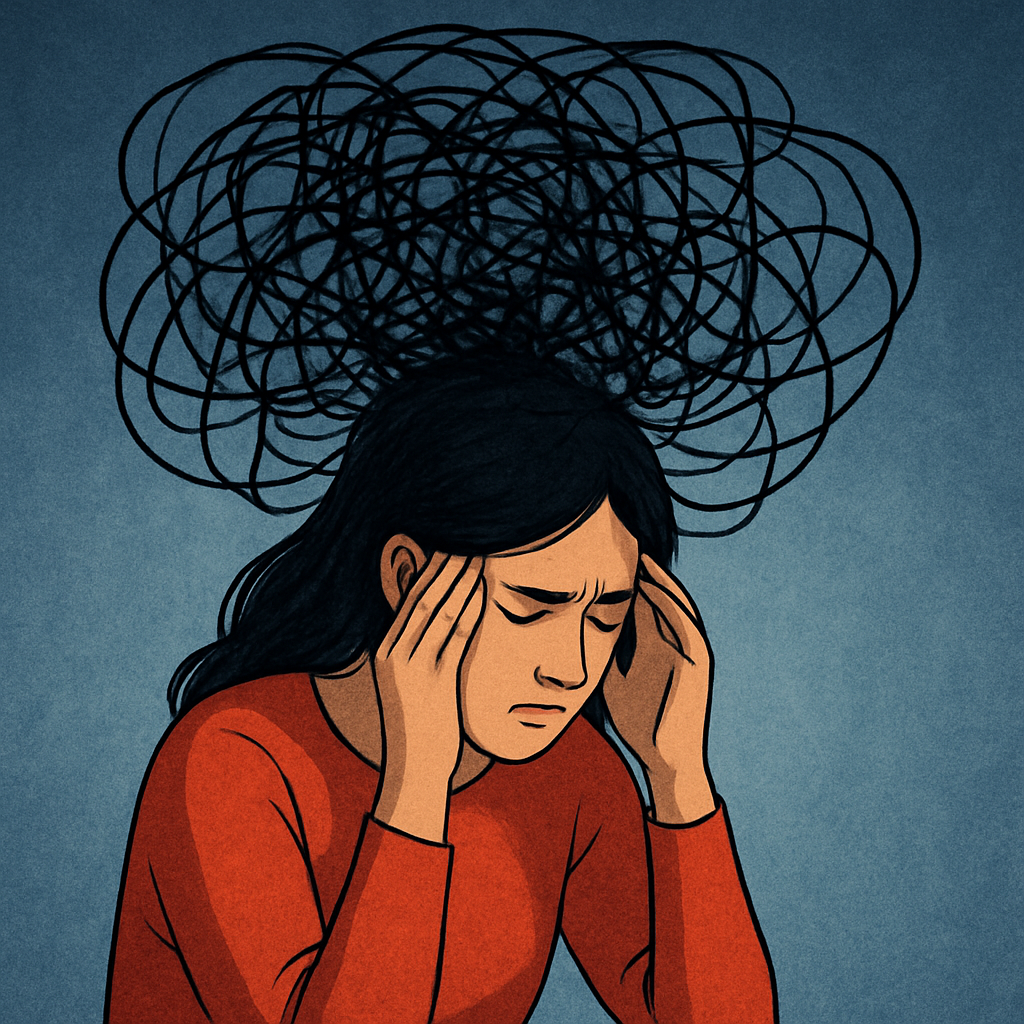
Does ADHD Cause Overthinking? What Therapists Know and How to Break the Cycle
Many adults with attention differences wonder: does adhd cause overthinking or is it a tangle of executive dysfunction, emotional intensity, and intolerance of uncertainty? This article unpacks the clinical mechanisms that make repetitive thought more likely in ADHD and summarizes the evidence clinicians rely on. Then you get a compact, therapist-tested toolkit — time-limited worry windows, externalization workflows, ADHD-adapted CBT and DBT scripts, and clear guidance on medication and when to seek expert help.
How clinicians differentiate overthinking, rumination, worry, and perseverative cognition
Clinicians separate repetitive thought into distinct targets because treatment changes depending on which process is dominant. In practice we do not treat overthinking as a single symptom; we identify whether the loop is primarily a past-focused critique, a future-focused threat simulation, or a physiological, ongoing stress response. That choice guides whether the first intervention is a behavioral experiment, a time-limited worry window, an externalization workflow, or a physiological regulation skill.
How clinicians tell them apart in session
- Temporal focus: Rumination skewed to the past; worry oriented to future possibilities; perseverative cognition often lacks clear temporal bounds and feels like cognitive background noise.
- Primary function: Rumination maintains self-criticism; worry aims to prevent threat; perseveration signals unresolved stress or overloaded executive function.
- Behavioral correlate: Rumination -> replaying events; worry -> checking/planning loops; perseveration -> repetitive mental rehearsal despite no problem-solving progress.
- Physiology and duration: Worry and perseverative cognition more likely to show sustained sympathetic arousal; rumination often co-occurs with low energy and depressed mood.
- ADHD interaction: Executive function limits and emotional intensity in ADHD can blur categories — what looks like worry may be executive overload masquerading as planning.
Practical limitation: Distinctions are useful but messy in real clients.** Adults with ADHD commonly present mixed patterns; a single episode can start as problem-solving and slide into rumination once working memory is taxed. That means clinicians often run brief behavioral tests in session to see which target shifts first when we alter context or introduce a micro-intervention.
Concrete Example: A client replays a date for hours and feels shame and self-critique — this is rumination so we prioritize self-compassion framing and behavioral activation to break the replay loop. Another client spends hours planning what to say in a meeting and still feels unprepared — this is worry/intolerance of uncertainty and responds better to time-limited worry windows and small exposure experiments. In ADHD both presentations frequently need external scaffolding like voice memos or Kanban boards to offload working memory.
Key distinction: identify whether the thought loop's job is to punish, to prevent, or to keep the body in a stress state — that determines the first skill you teach.
Short assessment script you can use now: When a loop starts, note Is this replaying a past event or predicting the future? Rate distress 0-10. Ask yourself what do I feel pushed to do right now — fix, avoid, or prepare? This rapid triage tells you whether to grab a mindfulness anchor, a 10-minute worry window, or an externalization tool.
Next consideration: Once you can reliably categorize the dominant pattern, choose an evidence-aligned intervention — the rest of this article shows therapist-tested techniques keyed to each category and how to adapt them for ADHD. For clinical background on ADHD and comorbid cognitive patterns see NIMH on ADHD and review approaches at Therapy for Adulting ADHD therapy.
Mechanisms that connect ADHD traits to repetitive thinking
Core assertion: ADHD does not magically create overthinking as a single symptom; instead, several interacting cognitive and emotional processes common in ADHD raise the probability that thinking will get stuck in loops. Clinically, those processes are predictable and therefore treatable, but they require different levers depending on which mechanism is dominant.
Executive limits and working memory pressure: Limited working memory means incomplete tasks live in consciousness as unresolved tokens. When the brain cannot hold a plan and the next steps together, it replays possibilities to feel productive. Practical insight: external scaffolds reduce the load, but they only work if the scaffold is simple and reliably used; complex systems fail because executive dysfunction prevents consistent setup.
Emotional amplification: Strong, quickly changing emotions common in ADHD lengthen thinking loops because feelings add salience to thoughts. A small social stumble becomes a layered narrative instead of a moment. In practice this means emotion regulation skills are often the first clinical target when rumination is high, not more cognitive restructuring alone.
Intolerance of uncertainty and decision paralysis: When making a choice feels risky, the brain treats repeated simulation as error prevention. That looks like overanalysis but functions as avoidance of committing to an outcome. Trade off: behavioral experiments reduce the loop fastest, but they trigger discomfort up front; clinicians recommend short graded exposures rather than all or nothing bets.
Hyperfocus and sensory overload: Two opposite attention failures can both cause repetition. Hyperfocus locks the mind on a single scenario and lets it replay details; sensory overload fragments attention and produces mental rehearsal as a misguided attempt at control. Treatment differs: scheduled context shifts help hyperfocus, while sensory simplification reduces the cognitive chatter that fuels perseveration.
Concrete Example: A 31 year old client with inattentive ADHD fixates on a message from a date and replays possible interpretations for hours. In session we practiced a 2 minute externalization: write one sentence that describes the worst plausible outcome, then do a 10 minute behavioral experiment that tests that outcome in a reduced way. The client reported less replay that evening and used the one sentence as a reminder to limit reprocessing at night.
- If working memory is the driver: use single step commitments written on an index card and a visible timer to reduce cognitive load.
- If emotion amplifies thinking: teach a 90 second grounding routine and pair it with an emotion label to shorten the loop.
- If uncertainty causes paralysis: run a one hour graded experiment rather than debating hypotheticals for days.
- If attention stickiness or overload is present: institute predictable context shifts and reduce sensory inputs before bed to lower nighttime rumination.
What the research and clinicians observe: comorbidity and treatment implications
Direct answer clinicians give: when people ask does adhd cause overthinking the practical reply is that ADHD creates conditions that make repetitive thought much more likely, but it is rarely the sole cause. Comorbid anxiety or depression changes everything: it converts occasional looping into persistent rumination that drives impairment.
Research and clinic data converge on three consistent patterns. First, adults with ADHD have higher rates of anxiety and mood disorders, and those comorbidities amplify perseverative cognition. Second, improving core ADHD cognitive capacity — working memory, task switching, and reduction of cognitive noise — reduces vulnerability to getting stuck. Third, skills-only interventions without external scaffolding often fail because executive dysfunction prevents consistent practice.
Treatment implications clinicians rely on
- Screen for comorbidity: treat the anxiety or depression component aggressively when rumination is prominent because symptom overlap masks the true driver of repetitive thinking.
- Medication tradeoff: stimulants or atomoxetine frequently reduce background mental noise and improve response to therapy, but they do not automatically erase negative thinking patterns and can raise anxiety in some people.
- Combine coaching with therapy: CBT adapted for ADHD plus short, coached practice sessions beats generic anxiety handouts; therapists pair behavioral experiments with externalization tools so clients can offload working memory.
Practical limitation to plan for: medication shortens and quiets many thought loops but it is not a replacement for behavioral change. Expect faster cognitive bandwidth but still invest time in building external systems because executive function gains are necessary to make skills stick.
Clinical judgment that matters: if repetitive thought persists despite an adequate medication trial, clinicians usually reassess for untreated mood or trauma symptoms and shift to an exposure-based or acceptance approach rather than more cognitive restructuring. In practice, chasing more medication without skills training is a common and costly mistake.
Concrete Example: A 36 year old client with diagnosed ADHD and comorbid generalized anxiety was stuck in nightly replay of workplace mistakes. The treatment plan combined a medication adjustment to reduce cognitive noise, a 10 minute nightly brain dump routine, and two brief behavioral experiments to test feared consequences. Within six weeks decision latency shortened and sleep improved, though the client still used the brain dump each evening as their primary relapse prevention tool.
Key point: treating comorbidity and improving cognitive bandwidth are synergistic — medication helps therapy land, and simple external scaffolds help medication gains translate into reduced rumination.
Next consideration: when planning care, set measurable short term goals such as fewer minutes spent replaying an event, improved sleep, or one decision made within 24 hours. Those functional targets tell you whether the intervention mix is working rather than relying on vague progress reports.
Therapist tested interventions to break the overthinking cycle
Direct clinical position: effective intervention is not one skill but a short, repeatable sequence therapists teach and coach until it becomes automatic. In practice that sequence is: externalize, limit, test, regulate, and debrief. Each step trades depth for practicality—you reduce minutes spent looping first, then expand insight later.
Quick 5-step protocol clinicians use in session
- Externalize (0-2 minutes): get the loop out of the head fast — voice memo, one-line note, or a timed brain dump on an index card. Script to use: I will say/write one sentence describing the loop, then stop.
- Limit (2-5 minutes): set a strict boundary — a 10 minute worry window or a 7 minute reflection timer. Use a visible timer and promise yourself exactly one return only after the timer ends.
- Test (5-20 minutes): pick a micro-experiment that checks the worst credible outcome or reduces uncertainty. Keep it small and behavior-focused (call, send one message, or perform a short task).
- Regulate (90 seconds): a fast physiological reset after testing — paced breathing, TIP grounding, or a 60–90 second sensory anchor matched to ADHD attention span.
- Debrief and record (2 minutes): write one learning sentence and the next single step to take tomorrow. Store it where you will see it to prevent the loop from reigniting.
Practical insight and tradeoff: these steps prioritize stopping the loop quickly over deep cognitive analysis. That reduced rumination creates the bandwidth needed for therapy work later. The tradeoff is immediate emotional discomfort during the Test step—therapists recommend graded exposures rather than full challenges so you get data without overwhelming executive capacity.
Concrete example: A client who panicked before weekly team updates used the sequence for three meetings. She recorded a 30 second voice memo labeling the worst plausible critique, ran a 10 minute tiny-test by asking one clarifying question in the meeting, then did a 90 second paced breathing reset. Within three weeks she reported the pre-meeting replay shifting from hours to a predictable 10–15 minute prep routine and felt less stuck afterward.
What therapists watch for: repeated application without change usually signals one of three issues — the wrong primary target (emotion vs uncertainty), insufficient external scaffolding, or untreated comorbidity. If the protocol helps in session but dissolves at home, add accountability: share voice memos with a coach, schedule automatic timers, or book short check-in sessions to reinforce habit formation.
Small, consistent interrupts beat rare deep interventions for ADHD-related overthinking. Make the interrupt so low-friction you will actually do it.
Next consideration: pick one step to practice daily for two weeks rather than attempting the whole protocol at once. That creates habit bridges—externalization first, then timed limits—so you can see what reduces your particular loop before layering in experiments or medication discussions.
Practical step by step toolkit readers can use today
Start simple: pick one low-friction habit and run it for two weeks before adding another. The goal is reliable interruption and predictable follow-up — not insight-heavy therapy homework you never open.
Immediate interrupt: STOP – Note – Offload (use in a meeting or date)
How to do it: Stop what you are doing, take one breath, label the loop in three words, then offload to a quick capture. Use a single-line note in your phone or a 20 second voice memo. Promise yourself one scheduled return slot later and close the tab on the thought. Script: I notice a loop — label it briefly, save it, and I will return at noon for 5 minutes.
- Trigger: feeling stuck, replaying, or spiraling during a live interaction
- Action: 20s capture (note or voice memo)
- Contain: set a calendar block called Containment Slot for a specific time to review
- Move on: 60 second grounding (5-4-3-2-1 sensory sweep) and resume task
Nightly purge + morning anchor to reduce baseline churn
Evening routine: spend 8 minutes doing a focused purge: list 3 unresolved items, assign one tiny next action for each, and mark them with a priority tag in your task app. In the morning, glance at the three items and set a first-thing 15 minute slot to make progress. This creates predictable containment so thoughts stop trying to hold your attention overnight.
Decision fast-track for choice paralysis
Rule: limit decisions to a bounded process — 3-option rule, 10-minute cap, single-step commit. If you are choosing between A, B, or C, pick one using a pre-agreed tie-breaker (lowest effort, most reversible, or time-limited trial). Tradeoff: you accept small mistakes in exchange for ending rumination faster.
Concrete example: A project manager who stalled on vendor selection used the decision fast-track: she listed three vendors, set a 10 minute review, then committed to a 30-day trial for the chosen vendor. The trial structure reduced her two-week replay cycle into a one-hour decision and a follow-up check at 30 days, which cut office rumination and freed up evenings.
Tech wiring that helps: link your capture method to a visible system — Trello or Todoist board with a column called Contain, a repeating calendar slot, and a named voice memo folder. Tools only work if they are binary and obvious: capture or nothing. If you overcomplicate the workflow it will fail.
Next consideration: pick which driver matters most for you right now — emotional amplification, decision paralysis, or working memory overload — and use the matching micro-protocol above. Practice the habit until it becomes the default interrupt before layering in longer therapy work or medication decisions.
Two short clinical case vignettes showing therapy in action
What these vignettes show: practical assessment choices, the exact skills taught, and realistic progress markers clinicians track when answering the question does adhd cause overthinking. They are compact so you can see what a focused 6–10 week pathway looks like in real practice.
Case A — 27 year old, dating replay and social self-critique
Presentation: she reports nightly replay after dates, difficulty falling asleep, and avoidance of dating because she cannot stop running through every perceived social mistake. Baseline measures were a daily rumination log (average 75 minutes of intrusive rehearsal nightly) and Sleep Onset Latency ~45 minutes.
Assessment and targets: the clinician identified rumination driven by emotional amplification plus working memory overload. The short plan focused on two targets: immediate interruption of the loop and graded exposure to social uncertainty.
Session structure and homework: 50 minute sessions weekly for 8 weeks. In-session work combined a one-sentence capture exercise (voice memo), a 10 minute time-limited review slot scheduled the next day, and a 3-step graded exposure (send one low-stakes follow-up text, attend a 20 minute social meet, then debrief). Homework was a nightly 6 minute purge and a two-item morning anchor.
Outcome and tradeoff: by week 6 nightly replay dropped to ~20 minutes on average and sleep latency improved to ~20 minutes. Tradeoff: exposures initially increased acute anxiety for 24–48 hours; progress required tolerating short-term discomfort to break the loop. Clinician judgment: exposures plus a rigid capture routine changed behavior faster than cognitive reframing alone.
Case B — 38 year old, software engineer with code-review paralysis
Presentation: persistent overthinking about code reviews led to multi-hour rumination sessions, missed deadlines, and nighttime problem rehearsal. He reported an average of 3 hours/day spent reprocessing work and repeated avoidance of decision commits.
Assessment and multimodal plan: clinicians found executive overload plus intolerance of uncertainty. The team recommended a coordinated approach: brief prescriber consult to trial medication adjustment, plus therapist-led ADHD-adapted CBT exercises emphasizing one-step commits and externally visible progress tracking.
Therapy flow and measurable markers: two 30 minute skills-coaching calls per week for three weeks, then weekly psychotherapy check-ins. Practical tools: a visible Kanban column called Contain, a 10-minute commit rule (code pushed as a 30-day feature flag), and a daily 5 minute rumination tally. Tracked metrics: minutes spent reprocessing/day, number of commits per week, and self-rated decision latency.
Results and limitation: after 10 weeks reprocessing fell from ~180 minutes/day to ~30 minutes/day, commits per week rose from 0–1 to 3–4, and decision latency shrank from multiple days to under 24 hours for routine items. Limitation: medication reduced baseline cognitive chatter but without the structured commit rule gains were not sustained — the scaffold mattered. Clinician verdict: medication opened the window for behavior change; the external system made the change durable.
Both vignettes illustrate one consistent reality: reducing minutes spent looping is the pragmatic first goal. That creates the bandwidth needed for deeper cognitive and emotional work.
When to seek professional help and what to expect at Therapy for Adulting
Direct point: if repetitive thinking is costing you sleep, steady work performance, or relationships, it is time to involve a clinician. Many readers ask does adhd cause overthinking — clinically the answer matters less than the functional impact. When rumination replaces action or creates safety risks, self-help stops being enough.
Clear reasons to book an assessment now
- Significant functional decline: repeated missed deadlines, relationship fallout, or job loss tied to replaying or indecision.
- Persistent sleep collapse: racing thoughts that regularly prevent falling asleep or cause multiple nightly awakenings.
- Safety or crisis signals: intrusive thoughts that include harm to self or others, or sustained hopelessness — seek urgent care.
- Stalled despite practice: you have tried capture routines or simple scaffolds for several weeks with little to no change.
- Short-circuiting daily life: decision paralysis that forces you to avoid routine tasks or repeatedly defer commitments.
Practical insight: asking for help earlier shortens the path to useful change. Waiting until a single crisis can mean more intensive care is needed; addressing patterns when they are measurable (minutes spent ruminating, number of avoided decisions) gives clinicians clean targets to improve quickly.
Concrete example: Marcus, a 32-year-old, lost a contract after spending days replaying a client conversation instead of sending requested updates. At intake we measured decision latency and daily rumination minutes, started a two-week capture-and-contain routine, and arranged a prescriber consult; within four weeks his commits increased and rumination time dropped by half, stabilizing his work performance.
What to expect at Therapy for Adulting
- Focused intake (50–75 minutes): brief history of attention and mood, targeted questions about thinking loops, and baseline functional measures (sleep onset, decision latency, minutes/day spent reprocessing).
- Collaborative goal setting: we define 1–3 concrete, measurable goals (example: reduce nightly replay from 60 to 20 minutes; make one decision within 24 hours).
- Early skills-first plan: short, coached modules (2–4 week micro-protocols) that prioritize interruption and externalization before deep cognitive work.
- Coordination when needed: if medication is helpful, we set a prescriber consult and align skills training so cognitive gains stick.
- Check-ins and measurement: progress tracked with simple metrics so adjustments are rapid — this prevents drifting into generic advice that fails with executive dysfunction.
Trade-off to know: therapists here will often push for quick behavioral changes over long insight sessions at first. That feels unsatisfying to people who want to understand every thought, but it produces measurable relief faster. Expect short-term discomfort during graded exposures; the payoff is reduced time spent stuck.
If overthinking is reducing your functioning or safety, early assessment speeds recovery. For targeted care and booking options see Therapy for Adulting ADHD therapy or book a consult.